


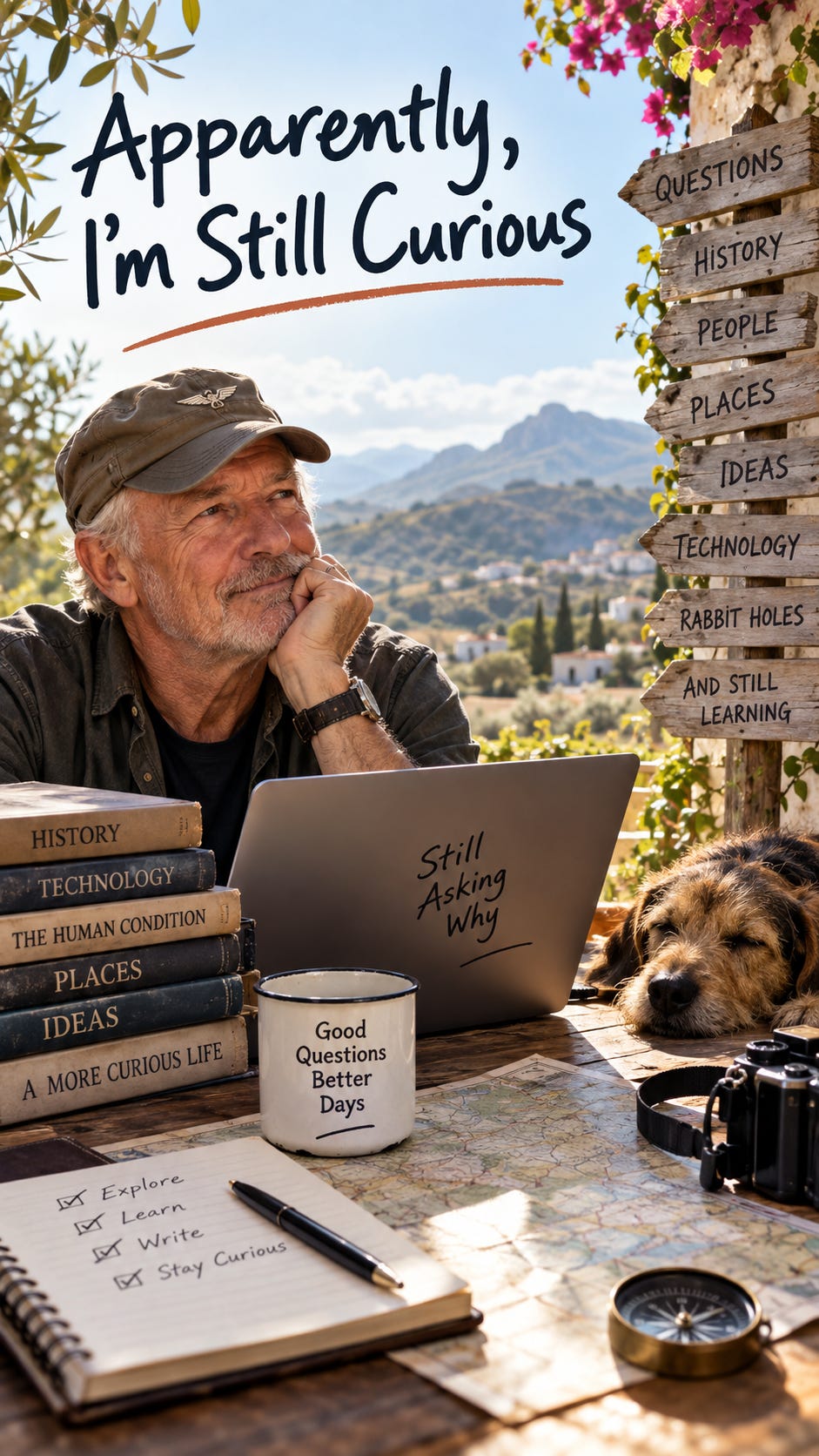
I had always assumed that getting older would eventually make me less curious. Not dramatically, perhaps, but gradually...like a tap being turned down rather than switched off. At some point, I imagined, I would simply know enough. I would have seen enough, experienced enough and made enough mistakes to reach that comfortable stage of life where very little could surprise me anymore.
It turns out I was talking complete rubbish.
At 66, I seem to be at least as curious as I was when I was younger, although the nature of that curiosity has changed somewhat. When you’re young, curiosity is often about the future. What will happen? Where will I go? What will I become? Who will I meet? Will I make any money? Will I ever own a decent car? Will women eventually stop being completely mysterious? Some of those questions, of course, remain unresolved, although I have accumulated enough evidence by now to conclude that the last one may be a lifelong research project.
The difference now is that I am much more interested in understanding things than I am in trying to become something. Perhaps that is one of the quieter privileges of getting older. You become less concerned with constructing an impressive version of yourself and more interested in poking around inside the world simply because something has caught your attention.
I find myself doing it all the time. I’ll come across some obscure historical fact, and suddenly I’m down a rabbit hole an hour later, reading about a person who died in 1734 and whose name I had never previously encountered. I’ll wonder why a particular piece of technology works the way it does and, before I know it, I’m reading documentation written by someone who clearly assumes I possess a degree in electrical engineering. Sometimes I do not, but that doesn’t necessarily stop me.
The internet, for all its faults, has made curiosity almost ridiculously easy. When I was growing up, finding out something obscure could require a trip to the library, a conversation with somebody who knew more than you did, or one of those enormous encyclopaedias that seemed to occupy half the living room. Now almost any question can send you somewhere interesting within seconds. Of course, the downside is that the same machine that allows you to investigate medieval bread-making can also convince you that a man on YouTube has discovered the secret reason pigeons are watching us, so a little judgement remains useful.
That, perhaps, is another thing age has given me...not necessarily more knowledge, but a better understanding of how little I actually know. When I was younger, I sometimes mistook confidence for knowledge. I suspect most people do. You learn a few things, develop opinions, discover that you can argue reasonably well and then quietly assume you’ve got the world pretty much worked out. Then life starts throwing things at you.
People surprise you. Institutions behave differently from what you expected. Friends disappear from your life, and strangers sometimes become important. Things you once considered certain turn out not to be certain at all. You discover that two apparently intelligent people can look at exactly the same evidence and reach completely different conclusions. Eventually, if you’re paying attention, you become a little more comfortable with uncertainty, and I rather like that.
There is something liberating about being able to say, “I don’t know.” Not as an admission of defeat, but as an invitation. I don’t know...so let’s have a look. That attitude has followed me into writing, perhaps more than anything else. I don’t write because I believe I have finally discovered the answers to everything. Quite the opposite. Most of the things I write about begin with a question that has irritated, amused or intrigued me sufficiently that I want to pull at the thread.
Sometimes the thread leads somewhere useful. Sometimes it leads to another thread. Occasionally it leads to three hours of research, seventeen browser tabs and the sudden realisation that I have forgotten to eat lunch. Such is scholarship.
I suspect curiosity is also one of the reasons I have never been particularly good at the idea of retirement as simply stopping. I understand the attraction. After decades of work, there is something deeply appealing about being able to say, “That’s it...I’m done,” and walking away from the alarm clock. But I have never really understood the idea that retirement should mean retiring from curiosity as well. What exactly are we supposed to do with all those years of accumulated experience? Sit in a chair and wait for the biscuits?
There is still an enormous amount to investigate. The world remains gloriously strange. Human beings remain endlessly complicated. Technology changes faster than most of us can comfortably keep up with. History continues to reveal that many of the things we were taught as simple stories were nothing of the sort. Science keeps discovering things that make yesterday’s certainty look rather quaint.
And then there are the ordinary things. I remain fascinated by ordinary life because, frankly, it is where most of the interesting stuff happens. How people adapt. Why families develop particular traditions. Why one village does something completely differently from the village twenty miles away. Why food matters so much to memory. Why certain songs can transport you back forty years within the first few seconds. Why a smell, a photograph or a particular phrase can suddenly open a door into a part of your life you thought had been packed away permanently.
These things don’t appear particularly revolutionary. They are simply human, and perhaps that is what I find myself increasingly curious about...the human bit.
After a lifetime of organisations, rules, systems, technology, politics, bureaucracy and all the other machinery we’ve constructed around ourselves, I find myself more interested than ever in what sits underneath it. People. What makes us tick? Why do we believe what we believe? Why do some people cope brilliantly with adversity while others fall apart? Why do we cling to ideas even when the evidence has moved on? Why do we sometimes behave with extraordinary kindness and, at other times, behave like complete bloody idiots?
I don’t expect to solve any of these questions, but I enjoy asking them. Perhaps that’s the real surprise of getting older. I had imagined that age would gradually narrow my world. Instead, in some respects, it has expanded it.
There are fewer things I feel I need to prove, fewer arguments I feel obliged to win and less concern about whether somebody else thinks I’m doing life correctly. There is considerably more willingness to follow an interesting thought simply because it is interesting. That feels like freedom of a sort.
It also makes the modern world rather amusing to observe. We have somehow managed to create a civilisation in which people carry a supercomputer in their pocket, capable of accessing most of the accumulated knowledge of humanity, and then use it primarily to photograph their lunch and argue with strangers about politics. Perhaps humanity still has a little work to do, but I don’t despair about it. Curiosity keeps getting in the way.
Every now and then I discover something that makes me stop and think. A new piece of information. An old story I’d never heard. A scientific discovery. A technological development. Something somebody says in passing. Sometimes even a conversation that starts as complete nonsense and ends somewhere unexpectedly profound. Those moments remind me that there is still plenty of life left in the old dog yet.
Not because I have some grand plan to conquer the next twenty years. I don’t. These days, I’m rather fond of simply seeing what turns up. I want to keep writing. I want to keep learning. I want to keep asking awkward questions. I want to keep wandering down the occasional intellectual rabbit hole and emerging several hours later wondering why I now know the mating habits of an obscure species of beetle.
I want to remain capable of changing my mind when the evidence deserves it. I want to be surprised. And perhaps most importantly, I don’t want to become one of those people who have stopped looking.
Because there is a peculiar sadness in deciding that you already know enough about the world. The moment you do that, the world becomes smaller, and I’m not ready for a smaller world yet.
At 66, I still don’t know what I want to be when I grow up. Which, when I think about it, may actually be rather good news. It means I’m still looking.
And apparently...I’m still curious.



As our lives steady into a predictable course as we age, we reach a point of just having to accept the hand that life has dealt us rather than thinking about what's next. Banishing this kind of 'what comes next?' thought process frees up time to put our mind to other tasks, which can be just as stimulating but with so much less stress. As a former encyclopedia/library kid myself, the internet has made being curious much more enlightening than tiring.
Beautiful piece of writing!
I'm 74 instead of 66, but I am definitely as curious as I ever was if not more so. Also like you, I have a much better idea now of how much I don't know, and I really like suspecting a thing or process or pattern is a certain way but not being altogether sure. About the only thing I'm certain of is that there's almost nothing I'm certain of! One way I'm not like you and wish I could be is that I still care too much what other people think. It doesn't affect my actions so much. But inside I feel it.