


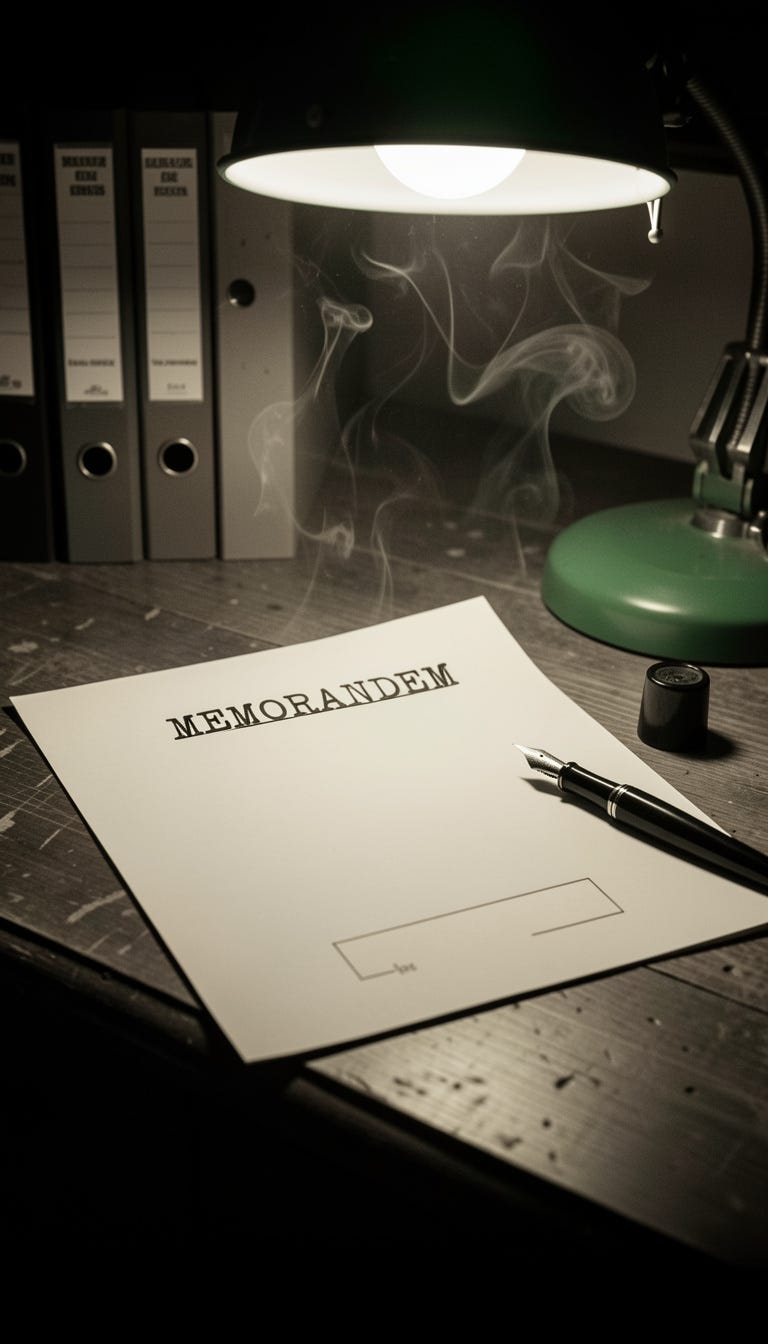
MEMORANDUM
TO: All Readers (whether you like it or not)
FROM: D. O. Markham, Operations Manager (Retired), otherwise known as Mr Memo (Unretired)
DATE: The weekend. Coffee in hand.
RE: Matters Requiring Your Attention
CLASSIFICATION: Unrestricted. Finally.
1. Background
Somewhere, in a skip or a shredder or the damp back corner of a storage unit on an industrial estate, there are probably still a few ring binders with my name on them. Fat ones, the kind with the stiff lever arch that tries to take your finger off every time you open it. Inside them, page after page of A4, each one headed with that same confident little word in bold capitals... MEMORANDUM... and at the bottom of each, a neat box with lines for a name, a signature and a date. Dozens of signatures. Hundreds, eventually. Supervisors, officers, contractors, the occasional very reluctant Director. All of them confirming, in their own handwriting, that they had read and understood whatever it was I had decided they needed to read and understand that week.
I became, over time, known as Mr Memo. I’d like to tell you it was a title bestowed with reverence, perhaps at a small ceremony, but it wasn’t. It arrived the way all workplace nicknames arrive, which is sideways, in a corridor, followed by a snigger that stops just a fraction too late when you walk round the corner. I think the first time I heard it was someone at the end of a radio call saying “Mr Memo’s on the prowl again,” not realising the button was still pressed. I laughed. I also, if I’m honest, went back to my office and wrote another memo.
2. How a Military Man Ends Up Married to a Photocopier
To understand Mr Memo you have to understand where he came from, and he came from the RAF Police, where there is a principle drummed into you so early and so thoroughly that it stops being a rule and becomes a sort of religion. If it isn’t written down, it didn’t happen. Your pocket notebook was your alibi, your witness and your conscience all at once. You wrote down the time, the place, who said what, who was present and what you did about it, and you wrote it down then, not later, because later is where memory goes to be creative. I learned very young that the truth is a fragile thing and that paper is one of the few materials strong enough to hold it still.
So when I left the service and dropped into a senior position in civilian security, as an Operations Manager plus a couple of other bits and pieces that seemed to attach themselves to my job description like barnacles to a hull, I brought that religion with me. And I discovered, rather quickly, that the civilian world did not share it. The civilian world ran on something far more dangerous. It ran on “I’m sure someone mentioned it.”
You’ll know the phrase. It’s the verbal equivalent of a fire door propped open with a fire extinguisher. Everybody can see it’s wrong, everybody assumes someone else will deal with it, and nobody wants to be the person who says anything, because saying something means owning it. Instructions were passed on in canteens and car parks. Procedures lived in the heads of people who were about to go on annual leave. Directives from above arrived as a vague mood rather than a clear sentence, and by the time they had filtered down through three layers of management they had the shape and reliability of a rumour.
I couldn’t bear it. So I did the only thing a former RAF copper knew how to do. I wrote it down, and then I made everyone else confirm they had seen it written down.
3. The Art of the Open Memo
My memos were never private. That was the whole trick of them. I didn’t send a quiet word to the one officer who kept leaving the key cabinet unlocked, I wrote an open memo to everyone about key control, so that nobody could claim ignorance and nobody could feel singled out, and the officer in question could read it along with everyone else and feel that faint prickle on the back of the neck that tells you someone has noticed.
They addressed everyone. Staff, supervisors, managers, and yes, on occasion, Directors, which went down about as well as you might imagine. They highlighted whatever needed highlighting... lone working procedures, incident reporting, the correct use of the visitor log, the incorrect use of the visitor log, the reasons why “N/A” is not an acceptable entry in a column headed “Time Out.” They set out the expectation, they set out the consequence of not meeting it, and then came the part people really loved, which was the signature box. Read, understood, acknowledged. Sign here, print your name, date it, and return it to me.
And they did return it, mostly. Some came back with coffee rings. Some came back with signatures so theatrically illegible that they were clearly a protest in themselves. One, which I kept for years out of sheer admiration, came back signed “M. Mouse.” But they came back. And every one of them went into a binder, and every binder went onto a shelf, and the shelf grew, and so did the legend of Mr Memo.
Those were the days of print, and I do miss them a little. There was a physical weight to a memo. You could hear it arrive in your pigeonhole. You could feel the warmth of it coming off the photocopier, smell that faintly scorched toner smell that meant something official was happening. An email can be ignored, archived, lost in a folder called “Misc,” but a sheet of paper on your desk with your name on the distribution list sits there looking at you like a disappointed parent until you deal with it.
4. The Knock on the Door
People laughed at Mr Memo. I knew they did, and I didn’t much mind, because I also knew something they didn’t, which was that every organisation eventually has a bad day. Something goes missing. Something gets damaged. Someone gets hurt, or nearly hurt, or complains, or sues, or an auditor turns up with a clipboard and the particular smile of a person who is paid to find things wrong. And on that day, all the laughing stops, and the question in every office becomes the same one. Were they told?
I lost count of the times someone knocked on my door on one of those days. Supervisors first, usually, looking a little sheepish. Then managers. And then, now and again, a Director, standing in my doorway with an expression somewhere between embarrassment and hope, asking whether I happened to have “that thing, the one everyone signed, about the procedure.” And I would stand up, walk to the shelf, pull out the binder, open the lever arch without losing a finger, and hand over the evidence. There it is. Dated, signed, returned. They were told. They understood. It’s in writing.
I won’t pretend there wasn’t a certain quiet satisfaction in that. The man they’d nicknamed as a joke turned out to be the keeper of the organisation’s memory, and not the flattering version of its memory either, the accurate one. The boardroom might set the direction, but the proof that anyone had actually been pointed in that direction lived in a small office, in a row of slightly battered ring binders, guarded by a bloke who was a bit too fond of the phrase “for the avoidance of doubt.”
It taught me something about institutions that I’ve never been able to unlearn. They will happily mock the person keeping the paper trail right up until the moment they need him, and then they will depend on him entirely, and the following Monday they will go back to mocking him again. That’s not bitterness talking. It’s just the natural rhythm of organisational life, as reliable as the tide coming in over the mudflats at Hull.
5. What the Signature Box Was Really For
Here’s the confession, and it’s one I only really understood long after I’d left. My memos were never really about communication. They looked like communication. They had all the ingredients of it, a sender, a message, a list of recipients. But what they actually were, underneath, was armour.
The signature box protected the organisation, of course. But it also protected me. If something went wrong, I could prove I had done my job. I had identified the risk, written the procedure, distributed it, secured acknowledgement. Nobody could say Markham hadn’t warned them. Every signed memo was a small sandbag against the flood of blame that sweeps through any workplace when things go badly, and over the years I built quite a wall of them.
I’m not ashamed of that. In a world that runs on “I’m sure someone mentioned it,” you’d be a fool not to protect yourself. But it does mean that for a large chunk of my working life, my writing wasn’t really mine. It was written for an overseer. Every sentence was shaped by the knowledge that someone above me might one day read it in a less forgiving light, that a solicitor might one day read it in a much less forgiving light, and that every word needed to be defensible. I wrote carefully. I wrote precisely. I wrote so that nobody could possibly misunderstand me. What I very rarely did was write what I actually thought.
6. The Unsupervised Years
And now look at me. Sixty six years on this planet, six decades of it spent learning things the hard way, and I’m sat outside a cave in rural Spain, with a small group of friends, no line manager, no Director, no auditor, no HR department and no signature box. Nobody signs off on what I write. Nobody approves it, amends it, softens it or asks me to “maybe run it past legal first.” If I think something is wrong, I say it’s wrong. If I think the emperor is not only naked but has been naked for several years and is now charging admission, I say that too.
There is a freedom in it that I find hard to describe to anyone who hasn’t spent decades writing with a ghost reading over their shoulder. The words come out in a different shape now. Looser. Warmer, sometimes. Angrier, other times. More honest, almost always. Mr Memo has not so much retired as been promoted to a position with no reporting line at all, and it turns out the old habit of writing things down so they can’t be ignored works rather well when you point it at the world instead of at a staff rota.
But I’d be lying to you, and I promised myself I’d stop doing that in print, if I told you it was all liberation. Because there’s something I’ve lost as well, and it’s the thing I was secretly best at.
Back then, I could prove I’d been understood. I had the binders. I had the signatures, even the Mickey Mouse one. When I put something out into the world, I got something back, a small, signed, dated confirmation that my words had landed in another human head and been acknowledged there. Now I write a piece, press publish, and send it off into the great digital fog, and I genuinely have no idea whether it’s been read, understood, half skimmed on a bus, or scrolled past between a cat video and an advert for a mattress. The occasional comment arrives, and I treasure those more than I’ll ever admit, but it isn’t the same. Mr Memo could prove comprehension. The writer on the hill can only hope for it.
7. Action Required
So here is my open memo to you, because old habits die hard and some of them shouldn’t die at all.
Please be aware that everything published under this name is written without an overseer, without approval and without a safety net. It reflects what I actually think, based on sixty odd years of watching how the world works, and occasionally how it doesn’t. Please be aware that I will get things wrong from time to time, and when I do, I’d rather you told me than quietly scrolled on. Please be aware that I still believe, with an almost religious conviction, that if it isn’t written down, it didn’t happen, and that the truth needs something solid to hold it still. These days that something is this page.
And please be aware that I’ve included the box below out of habit, and out of affection for the man who used to guard a shelf full of binders. I know you won’t sign it. I know it won’t come back to me with a coffee ring on it, or a theatrical squiggle, or a signature from a cartoon mouse. I’m not sure what it means that I’ve included it anyway. Perhaps some part of me is still waiting for the knock on the door.
✂ - - - - - - - - - - - - - - - - - - - - - - - - - - - - - -
ACKNOWLEDGEMENT OF RECEIPT
I confirm that I have read and understood the above memorandum and am aware of its contents.
Name: ____________________
Signature: ____________________
Date: ____________________
Please return to: Mr Memo, The Cave, Somewhere in Spain.





If your memos were anything like your Substack posts, your fellow employees must have enjoyed reading them.