
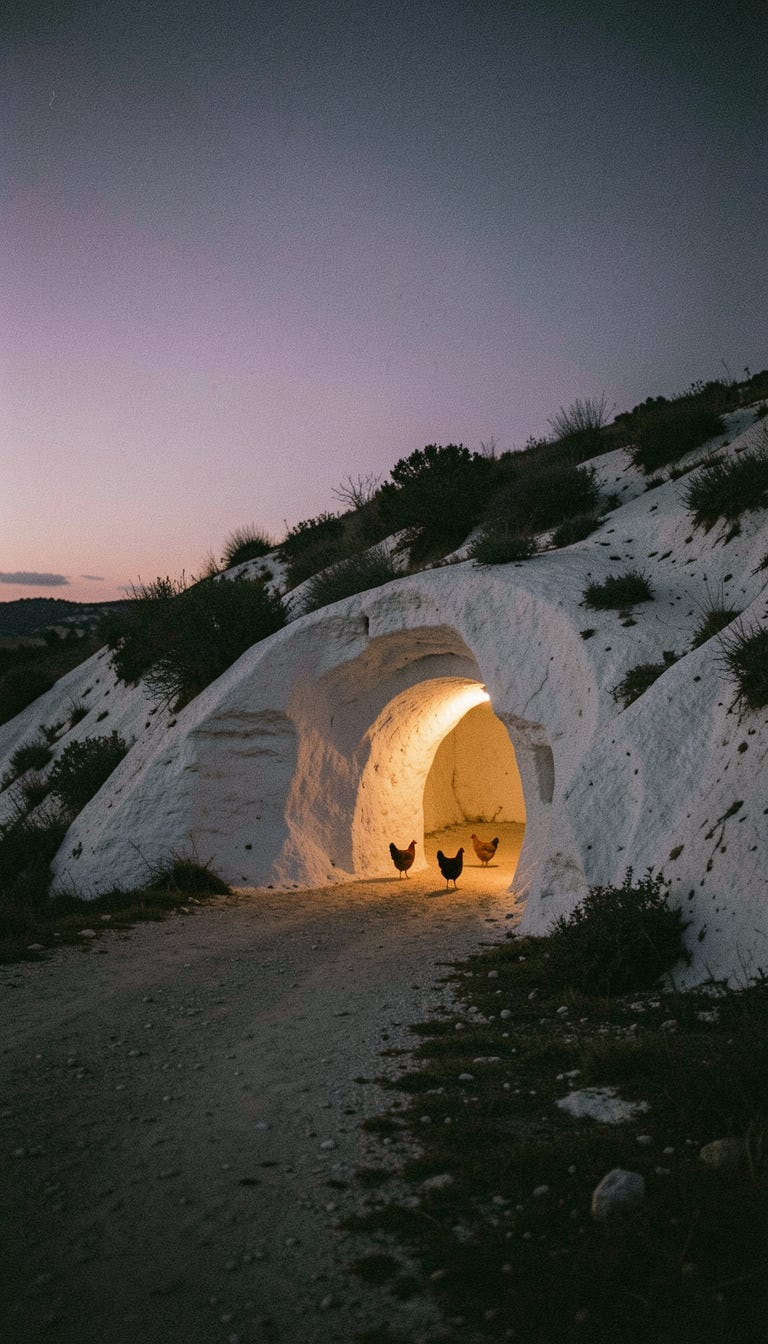
The chickens noticed before I did. Somewhere around the second week of October they start putting themselves to bed a little earlier, muttering in that disgruntled way hens have when the world stops running to their timetable, and by the time I’d clocked it the light over the altiplano had already gone the colour of weak tea. Autumn doesn’t arrive up here so much as seep in. The mornings grow teeth, the water butts develop a skin of something that isn’t quite ice yet but is clearly thinking about it, and the whole landscape starts to feel as if it’s packing up for the season... folding its deckchairs, counting its spoons, quietly getting its affairs in order. And with it, as reliably as the first frost, comes the annual migration of the living towards the dead.
In a few weeks it will be Todos los Santos, All Saints, and the village cemetery will be busier than the bar. Spain doesn’t do death the way I was raised to do it. Families turn up in force with buckets, brushes, tins of whitewash and armfuls of chrysanthemums, and they set about the nichos with the brisk efficiency of people spring cleaning a relative’s flat. Grandmothers supervise. Teenagers are dispatched for water. Somebody’s uncle holds forth about somebody else’s uncle, the plastic flowers that have been fading since last November are binned without ceremony, and the names on the marble are scrubbed until they’re legible again. Then everyone goes home and eats huesos de santo, little marzipan “saints’ bones”, which tells you everything about a culture that can take its mortality with a side of almond paste. It isn’t solemn, exactly. It’s attendance. The dead are visited the way you’d visit an elderly aunt who can’t get out much any more, and nobody seems to find this odd.
But the people in that cemetery, much loved and freshly whitewashed as they are, aren’t my oldest neighbours. Not by a very long way.
I’ve lived on the edge of Orce for nearly nine years now, and I still haven’t quite got over the fact that the hills I look at every morning hold some of the oldest human traces in Western Europe. A short walk from where I’m sitting, in the sediments of what was once a vast lake, archaeologists have dug up stone tools and a child’s milk tooth reckoned to be around 1.4 million years old. The lake is long gone, but for a while it was busy with hippos and mammoths, and patrolled by sabre-toothed cats and giant hyenas the size of a small pony, which rather puts my ongoing negotiations with the local foxes into perspective. Somewhere in that world a small child lost a tooth, and a million and a half years later a stranger with a brush found it. I think about that child more than is probably healthy. Nobody knows its name. Nobody ever will. But someone, presumably, noticed when it was gone.
The village’s most famous dead resident has a rather less dignified story. In the early 1980s, a fragment of skull was found nearby and announced, with some fanfare, as “Orce Man”, potentially the earliest European. Within no time, other experts were suggesting it might belong to a young horse or donkey, and the whole thing descended into the kind of academic punch-up that makes parish council meetings look like a yoga retreat. Careers were staked on it. Reputations were bruised. The man who found it spent much of his working life defending it. I find this enormously comforting, in a bleak sort of way, because it proves that even after a million years of being dead you still can’t escape politics. You can be reduced to a sliver of bone the size of a beer mat and somebody will still be arguing about whether you count. My most celebrated neighbour may be a donkey. I’ve had worse.
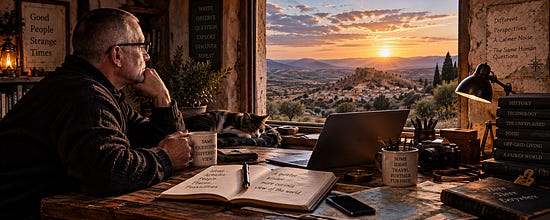
And then there’s me, a 66-year-old former RAF policeman living in a hole in a hill. I say that with affection, because cave living around here isn’t a gimmick or a lifestyle brand; it’s simply what people in this part of Andalucía have done for an awfully long time. The rock keeps you cool in August and warm-ish in January; it doesn’t care about your opinions, and it has absolutely seen tenants come and go before. Some nights, with the stove ticking and the wind having a go at the door, I’m acutely aware that I’m just the latest occupant on a very long lease. Humans have been sheltering in this landscape, hunting in it, burying people in it and being buried by it for longer than the concept of “Britain” has existed. It does tend to shrink your sense of self-importance, which, depending on who you ask, was overdue.
Here’s the thing that’s been nagging at me as November creeps closer. I grew up in a culture that treats grief as a private inconvenience to be managed discreetly, ideally within a twenty-minute crematorium slot before the next family files in and the curtain does its little electric shuffle. We British are very good at the stiff upper lip and very bad at the bucket and brush. We’ll buy a bench with a brass plaque on it, but we won’t turn up once a year as a family to scrub it. I’m not saying that’s wrong, exactly... I’m saying that watching my Spanish neighbours tend their dead in public, with laughter and gossip and pastries, makes the British way look less like dignity and more like avoidance with good manners.
It’s more complicated for those of us raised in service families. Forces children don’t really do family plots. You’re born in one garrison town, you grow up in another country, then another, and the people you lose along the way stay wherever life happened to be when they went. Colchester, Germany, Oslo, Hull... my map of the dead is less a family tree and more a list of postings. I suspect a lot of military families carry that same scattered quality around with them, an inheritance of graves you know about but never visit, because getting there means a flight, a hire car and a level of emotional organisation most of us can only manage on paper.
On paper, as it happens, is where institutions prefer their dead. A career in the RAF Police and then in security management taught me that organisations are superb at recording the dead and hopeless at remembering them. Names go into files, files go into archives, archives go into boxes, and the boxes go wherever boxes go to die. What I’ve noticed here is that remembering, actual remembering, the kind with whitewash under your fingernails, is something only people do. Which raises an uncomfortable question about which dead get remembered at all. The child with the milk tooth gets a glass case, a museum, funding bids and scientific papers. The villagers get their families with buckets. And everyone else, the ones whose families moved away or died out or simply forgot, gets a fading plastic rose and a slowly vanishing name.
That last group is growing, and not just in Orce. This village has been losing people for years now, part of what Spaniards bluntly call la España vaciada, emptied Spain. The young go to Granada, Madrid, Barcelona, or further, and they don’t come back except for weddings, funerals and, if the dead are lucky, the first of November. You don’t need to be an actuary to see where that ends up. A village of a few hundred where the cemetery is the only part of town still expanding. Niches with nobody left to clean them. The irony is almost too neat... a place that holds some of the oldest evidence of humans in Western Europe, quietly running out of humans, while its efforts to tell the world about its extraordinary dead remain so modest you could drive past them without noticing. I’ve said it before, and I’ll say it again: if the dead are this village’s greatest asset, someone ought to be shouting about them a little louder, before the living join them and there’s nobody left to do the shouting.
Which brings me, inevitably, to my own name on a slab. I’m an expat. I live with friends rather than family. In a culture where remembrance is carried out by blood relatives armed with cleaning products, I’m not entirely sure who turns up for the likes of me. My friends, possibly, if they outlast me, though they’re no younger and none of us has the knees for heavy scrubbing. The neighbours, maybe, out of a sense of village decency and mild curiosity about the English bloke who lived in the hill and talked to his chickens. The hens certainly won’t, they’ve made their position on loyalty very clear. It’s not a question I ask with any great self-pity. It’s just that you can’t live next door to a million years of the dead without occasionally wondering which layer you’ll end up in, and whether anybody will bother to dig.
Because that’s what we all become, in the end. A layer. The village cemetery is a stratigraphy of its own, newer niches stacked on older ones, the whitewash thicker on the beloved and thinner on the forgotten, and given enough time and enough emptying, it will be indistinguishable from the sediments in the hills. Some future stranger with a brush might find a hinge from a cave door, a chicken bone, a pair of reading glasses, and draw entirely the wrong conclusions about who I was. Then they’ll argue about it. I’d quite like to think somebody will argue about it.
Tonight the stove is lit, and the hens have gone to bed without consulting me. The hills are doing what they always do at this time of year, turning violet, then grey, then nothing at all. Somewhere out there a child lost a tooth a million and a half years ago, and somewhere down the road a family is already planning which flowers to buy. I still don’t know who’ll come with a bucket for me, or whether anybody should. I only know the dead around here are keeping their own counsel, as they always have, and that it’s getting dark earlier now.