


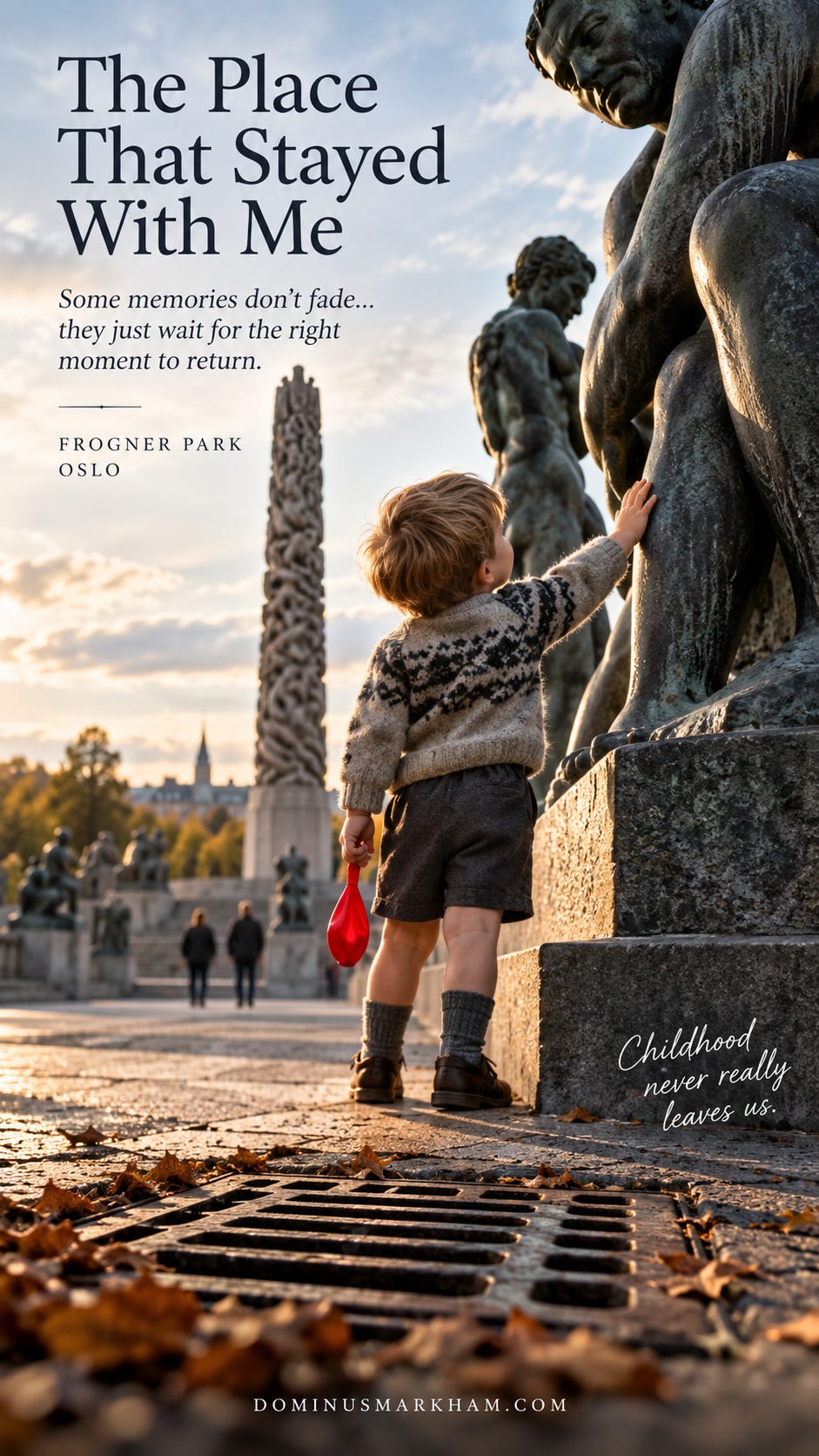
I was four years old when I lived in Norway.
That sentence sounds rather grand when I write it down, although to me it wasn’t grand at all. It was simply where we lived. My mum, dad, my two sisters and I were a family living in Norway, and Frogner Park in Oslo was one of those places that became part of the ordinary geography of childhood.
It wasn’t a tourist attraction to me. I didn’t know it was somewhere people travelled to see. I certainly had no understanding of its artistic or cultural importance. At four years old, I had considerably more pressing matters to occupy my mind, such as what my sisters were doing, where my parents were going and, apparently, the safe transportation of an uninflated balloon.
Yet more than sixty years later, I can still see parts of that park.
That is what fascinates me about memory. We tend to imagine that our childhood is stored somewhere in our heads as a collection of photographs, neatly labelled and filed away. It isn’t. Most of it disappears. Ask me to reconstruct an ordinary day from when I was four, and I wouldn’t have a hope. There are huge stretches of childhood that have simply dissolved into the general fog of the past.
But then there are fragments.
And some of those fragments are extraordinarily clear.
I remember Frogner Park. I remember the statues, particularly their forms and shapes. I remember looking at them with the sort of fascination that only a young child can have...before we learn that certain things are supposed to be looked at from a respectable distance.
I wanted to understand them.
So I touched them.
I remember the sensation of being small among these enormous human forms. To a four-year-old, scale is a very different thing. Adults are huge, buildings are enormous, and statues can seem almost otherworldly. I wasn’t standing there thinking about sculpture, symbolism or the work of Gustav Vigeland. I was simply a small boy encountering strange and remarkable shapes and trying to make sense of them.
Perhaps that is why the memory survived.
There is something wonderfully uncomplicated about the way children encounter the world. They don’t necessarily need an explanation before they become interested in something. They see it, they wonder about it and, if nobody stops them, they reach out and touch it.
And then there was the balloon.
An uninflated balloon, to be precise.
Somewhere in Frogner Park there was a drain cover, and somehow I managed to lose my balloon through it. I have absolutely no idea why I was carrying an uninflated balloon around a park in the first place, but apparently this was an important enough event for my brain to preserve it for the next sixty-two years.
Of all the things that happened during our time living in Norway, that tiny incident survived.
There is something almost comical about the filing system of the human brain. Major events can become blurred while something utterly insignificant remains sharp. A person can forget an entire conversation but remember the colour of a front door. They can forget what they ate yesterday but remember the smell of a childhood kitchen. They can lose the chronology of a year but retain the image of a particular tree.
Or an uninflated balloon disappearing beneath a drain cover.
Memory clearly has its own priorities.
For me, Frogner Park became one of those fragments of early life that remained quietly stored away. I grew up, of course. Life moved on. Norway became something from childhood rather than somewhere I was living. Other places replaced it, other experiences accumulated and the four-year-old boy who had wandered around that park became buried beneath everything that came afterwards.
Until recently.
I was watching a programme on television when I realised it was being filmed in Frogner Park.
At first it was simply a familiar landscape.
Then I recognised it.
And something happened that is difficult to explain unless you’ve experienced it yourself. The years seemed to fold in on themselves. I wasn’t deliberately remembering Norway. I wasn’t sitting there looking through old photographs or trying to summon up childhood memories.
The place simply appeared on the screen...and my mind knew it.
There were the statues.
Still there.
That was the part that really stopped me.
I had last known those statues as a four-year-old boy. I had looked at them, wondered about them and put my hands on them with the unrestrained curiosity of childhood. Then more than six decades passed.
And they were still standing.
Of course, intellectually, I know that statues don’t disappear simply because a child grows up. I know Frogner Park continued to exist. I know Oslo continued its life without the slightest concern for what happened to a small British boy who once wandered around it with his family.
But memory doesn’t operate intellectually.
Seeing those statues again created a peculiar connection between two versions of myself separated by most of a lifetime.
There I was, sitting watching television as an older man, looking at the same forms that a four-year-old version of me had once found so intriguing.
It made me wonder what it is that actually survives from childhood.
Perhaps it isn’t the events themselves.
Perhaps it is the feeling of being there.
I can’t tell you everything that happened that day in Frogner Park. I couldn’t reconstruct the route we took or tell you what we talked about. I couldn’t tell you what the weather was doing or what we had eaten beforehand. Those details have long since disappeared.
But I remember being there.
I remember being small.
I remember my family being with me.
I remember the statues.
And I remember a balloon disappearing down a drain.
In some strange way, that may be enough.
We spend much of our adult lives believing that we are moving forward. We plan the next year, the next house, the next job, the next journey. Childhood sits behind us as though it were another country, one we left long ago and to which we have no passport.
But perhaps it isn’t quite like that.
Perhaps all those earlier versions of ourselves are still somewhere inside us, quietly going about their business. Most of the time we don’t notice them. Then something happens...a song, a smell, an old photograph, a familiar landscape on a television programme...and suddenly the door opens.
For a few moments, the distance disappears.
Watching Frogner Park on television, I wasn’t simply remembering Norway.
I was remembering myself.
A four-year-old boy living in a country that, at the time, was simply home. A boy walking through a park with his mum, dad and two sisters, looking at strange and wonderful statues and trying to understand the enormous world around him.
A boy who apparently thought an uninflated balloon was worth taking for a walk.
And the remarkable thing is that the park is still there.
The statues are still there.
The stone and bronze have carried on standing while generations have grown up around them. People have walked past them, touched them, photographed them, and perhaps barely noticed them at all.
But somewhere in my mind, those statues are still being looked at for the first time.
By a little boy who didn’t know that one day, more than sixty years later, he would see them again on a television screen and suddenly remember.
Funny old thing, memory.
It doesn’t always preserve what mattered most.
Sometimes it preserves what mattered to us before we knew what mattered.





This:
‘Funny old thing, memory.
It doesn’t always preserve what mattered most.
Sometimes it preserves what mattered to us before we knew what mattered.’
You have captured the meaning of a life.