

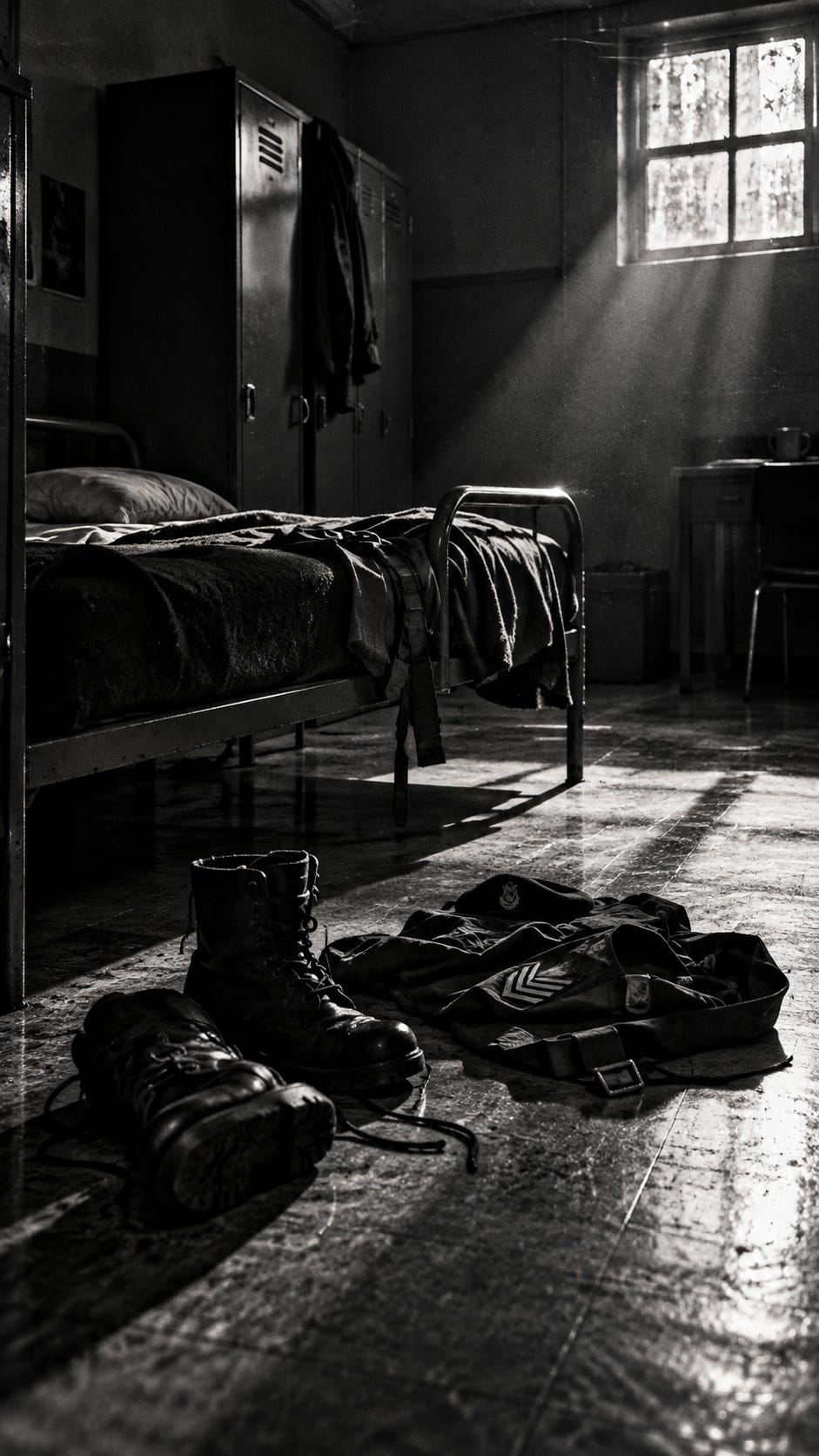
My kit hit the barracks room floor before I’d even finished laughing. I remember the sound of it more than anything, that soft, humiliating clatter of carefully folded kit and polished boots scattering across lino, and then the silence afterwards, the kind that only a room full of young recruits can produce when every one of them is thinking the same thing... thank God that wasn’t mine. I’d laughed because I knew, with absolute certainty, that everything on that bed was correct. The Drill Instructor knew it too. That, as it turned out, was precisely the problem.
I was 26 when I joined up, which in recruit terms made me something close to a pensioner. Most of the lads around me were barely out of school, still young enough to believe that the shouting was personal and the inspections were about kit. I’d already spent the best part of my life in Hull by then, knocking about in jobs and learning the things you learn when nobody’s paying you to be impressed, so I could see the theatre for what it was. The kit was never the point. The point was the performance of authority, and I had just stood in the middle of the stage and laughed at the actor.
I was told to report to him afterwards, and I went expecting the full treatment. What I got instead has stayed with me for forty years. He didn’t raise his voice. He simply explained, almost wearily, that I was older and I understood what was going on, but the others didn’t, and they needed to believe in it for now. Then he said something I’ve never quite forgotten: just don’t laugh in my face, please. That “please” did more to me than any amount of shouting could have managed. It was the first time I understood that institutions speak with two voices, the one they use in front of the room and the one they use when the door is closed, and that the second one is usually the one telling the truth.
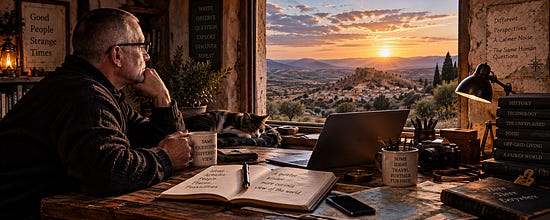
I hadn’t thought about that DI in years until a recent chat with an old RAF mate, now living on the other side of the world in Australia, shook the memory loose along with a good many others. It’s funny what comes back when two old service types start talking. You think you’re reminiscing about daft moments and characters and who ended up where, and then suddenly you’re sitting in a cave in rural Spain realising that half the way you live your life was set in motion by a handful of moments you’d filed away as anecdotes.
Because it happened again, later on, with considerably higher stakes than a pile of boots on a barracks room floor. And once again the official verdict and the quiet word turned out to be two very different things.
The exercise
Anyone who has served will know the rhythm of exercise days. They arrive with the regularity of weather, some of them genuinely testing and some of them little more than a box being ticked for someone further up the chain, and after a while you learn to read which is which from the faces of the people running them. This one was a threat scenario against a sensitive installation, the sort of thing we trained for precisely because nobody wanted to be doing it for the first time for real. Someone was playing the part of an intruder who had got closer than they should have, and they announced that they had explosives with them.
I’ll spare you the full blow-by-blow, partly because memory smooths the edges of these things and partly because the detail matters less than the moment. What matters is that the threat didn’t stay a threat. The person playing the aggressor began readying themselves to deploy those explosives into the sensitive location, and in that instant the scenario stopped being about conversation and started being about seconds. I did the maths the way we’d been trained to do it, and the maths said that if I waited for that device to go where it was going, there would be nothing left to negotiate about. So, within the rules of the game and technically speaking, I took them out.
I was removed from the exercise. The upper ranks, it seemed, had wanted the scenario to run a different course, one that presumably involved more talking, more escalation, more of the script they’d written in advance, and a young RAF Policeman ending it early was not in the plan. I remember standing to one side, feeling that peculiar mixture of certainty and doubt you get when the people with the most braid tell you you’ve got it wrong. You start to wonder whether you’ve misread the whole thing. You replay it. You look for the moment where you should have held off.
Then my Sergeant took me to one side. Not in front of anyone, not with any ceremony, just a quiet word away from the others. He told me he agreed with my decision. He’d seen what I’d seen, he’d done the same maths, and in his view the call was the right one, whatever the official verdict had to be. He couldn’t say it out loud in that setting, and I understood why, but he wanted me to know. It was the barrack room all over again, only this time the kit on the floor was a life, pretend or otherwise, and the quiet word mattered a great deal more.
I’ve thought about that Sergeant many times since. Not because he made me feel better, although he did, but because of what his quiet backing taught me about how risk is really managed. The people who write the scenarios are rarely the people who have to stand in them. The script says one thing, the moment says another, and the person closest to the danger is the one who has to choose which to believe. Institutions, understandably, prefer the script. It’s auditable. It can be defended in a meeting. The moment can’t. But the moment is where the explosives are.
Risk, whether it wears a uniform or not
Here’s the thing I’ve come to believe, and it’s the thing that probably makes some of the people around me think I’m a little odd. Risk assessment isn’t a military activity that you put down when you hand in your ID card. It’s a way of looking at the world, and I genuinely don’t think it matters whether the setting is warfare or a Tuesday afternoon at home. The questions are the same. What could go wrong here? What would I do if it did? What do I need in place so that when it does, I’m reacting with a plan rather than with panic? The scale changes. The logic doesn’t.
So I still do it. I notice where the exits are when I walk into a room. I think about what happens if the water stops, if the power fails, if the road out is closed, if something happens to one of the people I share this odd little life with. Living off-grid in a cave dwelling in rural Spain, a certain amount of that is simply common sense, because there’s no council van coming to fix things and no neighbour three doors down with a spare anything. But I’d be lying if I said it started here. I was like this long before the cave. The cave just gave me a respectable excuse.
People call it prepping, and I suppose it is, although that word has picked up a lot of baggage over the years, most of it involving bunkers, tinned peaches and a worrying enthusiasm for the end of the world. That isn’t me. I have no desire to be proved right about catastrophe. If anything, the whole point of thinking these things through is so that the catastrophe, when it’s a small one, stays small. A power cut is an inconvenience if you’ve planned for it and a crisis if you haven’t. The same is true of a flood, a fire, an illness, a broken-down car on a lonely road. Most disasters aren’t dramatic. They’re ordinary problems meeting unprepared people.
When friends raise an eyebrow at it, and they do, I don’t really have a better answer than that it feels like second nature. I don’t sit down and decide to assess risk any more than I sit down and decide to breathe. It just happens, quietly, in the background, like an app that never closes. And lately, prompted by that conversation with my mate in Australia, I’ve found myself wondering where on earth it came from.
Something in the blood?
I was born in Colchester into a military family, and that sentence explains more about me than I usually let on. My father served in the Royal Signals and rose to Warrant Officer Class One, spending his career in the long, cold, watchful years when Europe was divided and everyone half-expected the worst. He spent five years in Sudan. I grew up as a service kid, with formative years in Germany and in Oslo, and service families have their own way of seeing the world. You learn early that home is temporary, that plans change without warning, and that the adults around you are always, quietly, thinking about what happens next. Nobody sat me down and taught me risk assessment. It was simply the air I breathed.
Go back another generation, and there’s my grandfather, who served in both world wars, which is a sentence that still stops me in my tracks when I think about what it actually means. Two wars. Two entire lifetimes of danger folded into one. And somewhere in the middle of all that, he earned a gong for saving his Sergeant. I think about that more than I used to. A man who, in the moment that mattered, made a call and acted on it, for the sake of the man above him. And then, decades later, his grandson stood on an exercise ground having made a call of his own, and it was a Sergeant who stood quietly beside him. I’m not a great believer in neat patterns, but I’ll admit that one catches in the throat a little.
So is it genetic? Is there some tiny switch in the family line that flicks on when the world starts looking dangerous? Or is it upbringing, the inevitable result of being raised by people whose jobs required them to think in contingencies, in a family that moved around the map at the behest of the Cold War? Or is it simply that I joined the RAF Police at 26 with enough life behind me to take the training seriously, and it stuck the way things stick when you’re old enough to understand why they matter? I genuinely don’t know. I’ve turned it over and over, and every answer feels partly right and partly flattering.
The bit I can’t tidy up
What I do know is that it’s in me. It was in me when I laughed at that DI, because some part of me had already assessed the situation and decided the inspection wasn’t the real threat. It was in me when I ended that exercise early, because the maths was the maths and no amount of braid could make the seconds go slower. And it’s in me now, at 66, in a cave in Spain, when I check the water and think about the road and quietly work out what we’d do if.
I don’t think I’ll ever know for certain whether I inherited it, absorbed it or trained it into myself. Perhaps it’s all three, braided together so tightly that pulling them apart would be pointless. Perhaps the question itself is a bit of a comfort, a way of making something ordinary sound like destiny. What I do know is that the people who shaped me most weren’t always the ones giving the official verdict. They were the ones who took me to one side, closed the door, and told me what they really thought. The DI who said please. The Sergeant who said he’d have done the same. A grandfather I only know through a medal and a story, who once decided that another man’s life was worth the risk.
Maybe that’s where it really comes from. Not the genes, not the postings, not the training, but those quiet words, passed down and passed along, telling me that it’s alright to see the danger before everyone else does... and to act on it, even when the room would rather you didn’t.




Life itself is a game of risk assessment.
Now THAT was an experience I hadn't expected today. I felt like I was reading about myself through most of your post. Good god, we share a lot of the same stuff. I think the only thing we probably share, that you didn't mention, is that I not only judge situations in a certain way, but I also judge people in a certain way - as in, would I share a dangerous situation with that person. At 78, why do I still do all those things? I don't live in a cave, but I do live in an extremely remote place where water and power are BIG issues. I do have to stay prepared and maybe I thought it was just me and my father's and grandfathers' military experiences, but now I clearly see that I must have plenty of brothers across the globe. I am also writing a book right now (fiction, but based on my real experiences) that has brought up a lot of the things you talk about. Lastly, I recently finished a PTSD therapy course and that also brought up those issues. Anyway - nice writing. Related to it and enjoyed it. I don't subscribe because money is a huge issue - anything I get goes for the 77 animals here in our Rescue & Sanctuary. But if that wasn't the case, I would have subscribed!