
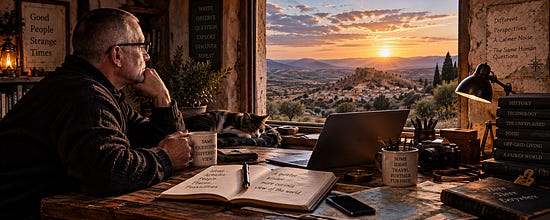

The first time I watched a group of vultures turning slow, lazy circles above the hills behind the cave, I did what any former RAF Police officer would do and assumed something had gone badly wrong for somebody. A career spent attending incidents will do that to a man. You see a crowd gathering, you start looking for the body. As it turned out, I wasn’t far off... it just wasn’t a human body, and nobody needed me to take a statement.
Living in rural Spain, rather than on the edge of a city in the UK, rewires you in ways you don’t notice until someone from back home asks what you’ve been up to and you find yourself enthusing about toads. In the UK, nature was something that happened in parks, on allotments, or when a herring gull mugged you for your chips on a day out at Brid. Out here it doesn’t wait to be visited. It arrives on its own timetable, and after a few years you start reading it like a calendar pinned to the kitchen wall.
The warm nights bring the scorpions out, and shaking your boots before putting them on stops being a quaint tip from a survival handbook and becomes muscle memory. In the depths of winter the foxes start their mating calls, and if you’ve never heard a vixen scream in the dark, I can only describe it as the sound of something being murdered very slowly... which, for a man with my professional history, is not an ideal thing to hear at three in the morning. Late winter and early spring bring the pine processionary caterpillars, marching nose to tail out of their silky nests in the pines, looking faintly comical until you learn what their hairs can do to a dog’s mouth. Then, after rain, the toads take over the night shift. The natterjacks and spiny toads set up a rattling, croaking chorus that sounds less like wildlife and more like a pub quiz arguing over the answers, and the spiny toads in particular carry toxins in the glands behind their eyes that no curious dog should ever get its jaws around. None of it is dramatic, exactly. It’s just a steady reminder that you are a guest here, and the residents have their own schedule.
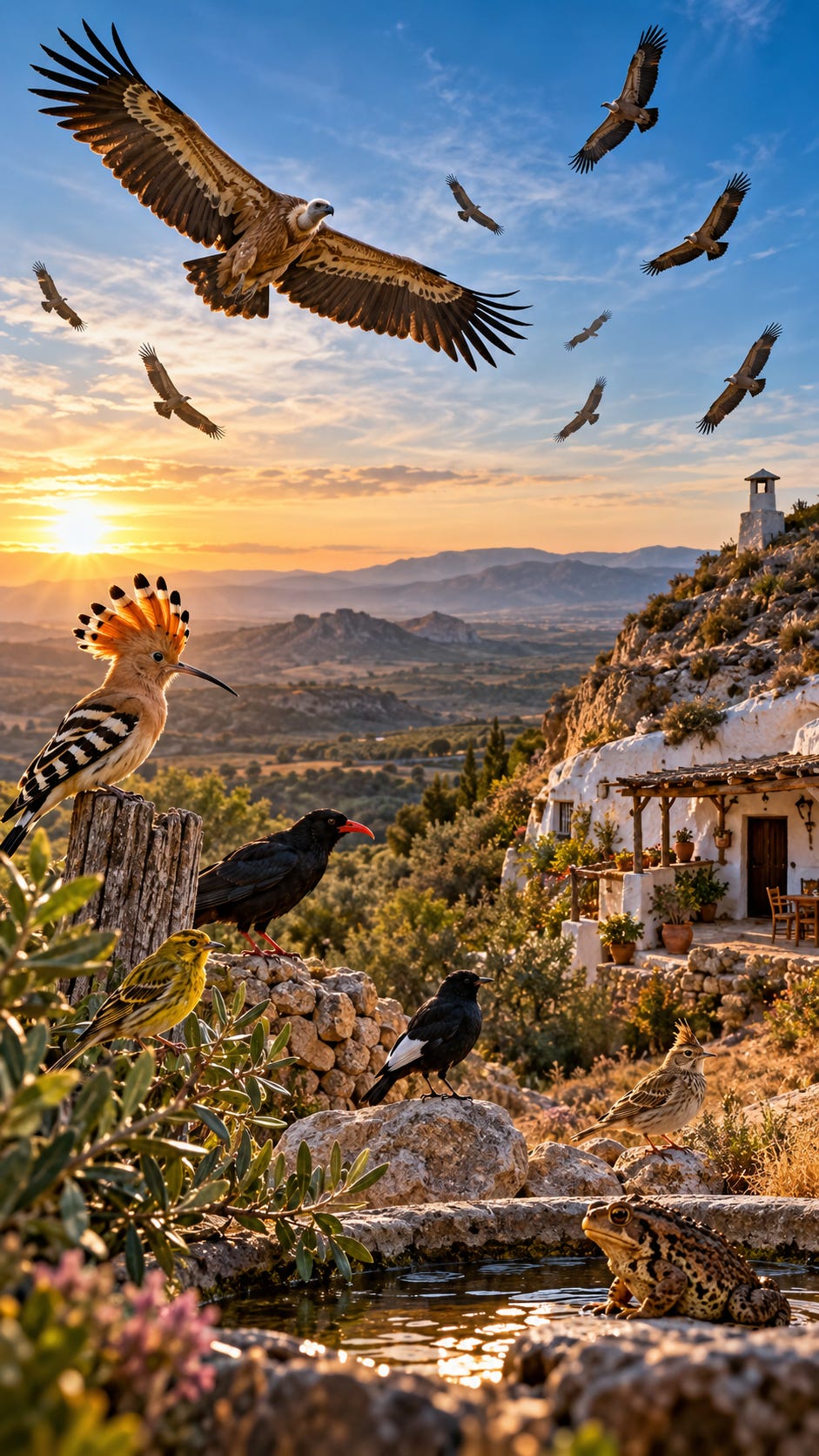
Which brings me back to the vultures. Up here we mostly see griffon vultures, and they are enormous, with a wingspan comfortably wider than I am tall, sailing the thermals for hours without appearing to flap once. I used to believe the romantic version, that a single “spotter” found the carcass and hovered over it to signal the rest. The truth is rather better. There’s no designated scout. Each bird flies high and spaced out, watching the ground below and, crucially, watching its neighbours. The moment one drops towards something, the next one sees it and follows, then the next, and a chain reaction ripples out across miles of sky. It’s a surveillance network built entirely on paying attention to your colleagues. I spent years in security management trying to build exactly that, and I’d have happily swapped half my staff for a few griffons.
The English language, bless it, has names for all of this. A group of vultures sitting about is called a committee, which feels about right given their hunched shoulders and air of having read the minutes and disapproved of them. Circling in the sky, they become a kettle. Once they’re down and feeding, they’re a wake, which is the sort of dark little joke the language occasionally allows itself. It’s worth saying, too, that not every kettle means a death. Quite often they’re simply riding the warm air because they can, and I’ve come to envy them that.
There’s a sardonic footnote to all this, as there so often is. After the mad cow crisis, European rules demanded that dead livestock be collected and incinerated rather than left where it fell. Spain’s vultures, who had been running an efficient, free, carbon-neutral clean-up service for a few million years, were effectively made redundant by paperwork, and many went hungry. The rules were eventually loosened once someone noticed the problem, but it remains one of my favourite examples of bureaucracy confidently solving a problem by creating a worse one.
Of course, the birds that fill most of our days are smaller. The familiar cast from the UK is here in force... sparrows everywhere, crows, pigeons, and magpies strutting about with the same air of low-level criminality they have in any English car park. But alongside them is a supporting cast that still stops me mid-sentence.
The hoopoe is the one visitors never believe until they see it. It looks as though it was designed by committee (the other kind), with a pinkish-orange body, zebra-striped wings, and a crest it fans out like a punk who’s just been startled. Its soft “oop-oop-oop” call is where the name comes from, and its reputation is less glamorous than its looks, because a nesting hoopoe defends its young with a foul-smelling secretion that would clear a room. Beauty and hygiene, it seems, are separate departments.
The red-billed chough is a crow that went to art school. Glossy black, with a curved scarlet bill and legs to match, it tumbles and rolls along the cliffs in flight as if showing off, and it has a fondness for rocky, cave-riddled country that makes us neighbours with remarkably similar taste in property. The black wheatear, all black apart from a bright white rump, has a habit I find deeply relatable... the males carry stones to the nest site, sometimes a great many of them, for reasons ornithologists still debate. A bird committed to home improvement with no clear plan is a bird after my own heart.
Thekla’s lark is a small, crested, sandy-coloured bird that looks almost identical to the crested lark, and birdwatchers will argue at length about bill shapes and streaking to tell them apart. I’ve stopped pretending I can and simply enjoy the song. The European serin is a tiny yellow finch that delivers a frantic, jingling song from the tops of wires and aerials, like someone rattling loose change in a pocket with real conviction. And then there’s the golden oriole, a summer visitor from Africa, the male a startling yellow and black, with a fluting call that carries through the trees. You will hear an oriole a dozen times for every once you actually see it. It is less a bird than a rumour with feathers.
The thing most tourists never grasp is that Spain has seasons. Proper ones. The summer visitors see one version of the country, sun-baked and shimmering, and go home assuming that’s the whole story. Up here the winters bite, with hard frosts and the occasional dusting of snow, and the bird population shifts with the calendar just as the scorpions and toads do. The orioles slip away south as summer fades, other species arrive, and the cast list quietly rewrites itself every few months.
What doesn’t change is the bird bath and the seed. When the reservoir supply goes down, as it does from time to time, and we’re back on the reserves, the bird bath still gets topped up. Priorities. The chickens regard the whole arrangement with open suspicion, as though the wild birds are freeloaders taking advantage of a generous landlord, and they may well have a point.
We know for sure they’ll be back. Or rather, we say we know, which is not quite the same thing. Every spring I catch myself listening for that first oriole a little earlier than I’d admit to, and every time a kettle of vultures appears over the ridge, I still glance up and wonder what’s happened, and to whom. Something somewhere has died, and something else will eat because of it. Out here, you stop finding that morbid. You start finding it honest.
Until Next Time

Technically Buzzards and Vultures are different: Buzzards belong to the Hawk Family (Accipitridae). Vultures belong to entirely different families—either New World vultures (Cathartidae) or Old World vultures (Accipitridae, shared with hawks and eagles). But hey we have to admit they seem similar
I recall back in about 2004 moving out bush alone to my block 4 hours drive west of brisbane and sleeping in a tent the first few weeks. First night I heard a woman screaming. Scared the hell out of me. Couldn't locate the noise but heard it a few more times. Each time further into the forest. I assumed it must be an animal like a koala or something. Only a couple of years ago did I remember this and think to check the internet. Vixens mating call.